Tuesday, 13 January 2015

Money generation - Where does the money come from?

In my new vision of the economy, currency is not generated by a central bank, but rather by the work of the labour force. In doing so, the available money that people have to spend should be more in line with the needs of society than if currency is simply generated by a central bank and loaned to the populace.
It should also be more evenly distributed, as it is being created into existence by the masses, and not a select few who will end up collecting far more than their fair share of the existing money supply. After one year of currency generation, the policy for currency creation is assessed by a body comprised of government and citizens in the labour force.
If it is determined that the amount of currency in the system is sufficient for the needs of the economy's population, currency generation via work will either cease for the next year, or be reduced by a certain percentage, to keep in line with population projections. The goal is to have an appropriate amount of currency available in the economy so that the entire population will have enough money to sustain their lives, without massive devaluation of the currency available.
A sustainable economy, in line with the availability of resources on the planet, is the end goal of this model – it is not to continuously grow, which is why, when a certain amount of currency is made into existence, creation of currency will cease unless it is decided that the total available currency needs to once again grow to meet the population's needs.

The Republic of Star Island would aim to keep its population stable. When the rest of the world eventually decides that this method of money creation is suitable, and that maintaining a stable population is more important than continuous growth, I hope that they will follow suit.

Just as the human population cannot grow forever, neither can the economy. At a certain point, the world's economy has to maintain, not to grow. Growing beyond our bounds will only hurt the biosphere, which will in turn hurt us, because we get our wealth from the biosphere. We need it, and it needs us to respect its boundaries.

CURRENCY VALUATION

Initially, the plan is for the Star Island Credit to be pegged to the value of the Canadian dollar at a 1:1 ratio, in order to make trading between the two entities easy to do. I would like to see pegging of currencies to others made a more standard practice globally, so that over time, currency unions such as the Eurozone can be encouraged to grow for the purposes of easing trade. However, countries should retain the right to revert to their own currency, so that, should it become economically nonviable to remain in a currency union, they can leave their union.

PHYSICAL CURRENCY

Physical currency (bills and coins) are not planned to be issued internally in Star Island - however, traveler's cheques, which could be converted to foreign currency and then back into Star Island Credits, would be issuable via the government.

The reason behind not issuing physical currency is ecological and economic in mind. Canada got rid of the penny because it was costing more to produce than the value of the penny was worth. Similarly, Star Island would not want to get into a situation where whatever material and process it was using to make physical currency proved economically nonviable. Trees would not need to be chopped down and turned into paper, nor would cotton need to be woven into bills, nor would metals need to be mined to produce coins, all of which become covered in bacteria and other debris from repeated handling by people as they are used. This reduction in resource use is a cornerstone of Star Island's ecologically minded outlook.

One perceived advantage to this approach is that nobody in Star Island needs to carry a wallet full of cash. The disadvantage, of course, is that technology can fail at any time, potentially leading to an inability to pay for things. In such cases, however, multiple systems can ensure that people still have access to their money.

(i.e. If people are shopping for food, and suddenly a power outage occurs, customers will still be able to leave with their food, because backup systems will be in place to account for what food has been taken out of the store during any outages in power, and who took what.)

Ideally, personal shopping carts would be directly linked to one's own personal bank at home, so to keep a record of items purchased on such and such a date. As well, both someone's personal shopping cart and home bank could have battery backups that would kick on in case of power failure in the island. All sorts of levels of backup would be in place to ensure that an entirely digital currency would not vanish due to unexpected occurrences, such as power outages, natural disasters, or something as simple as a fridge magnet going in the wrong place.

Saturday, 10 January 2015

Inflation is a scary thing

Inflation is a scary thing.

In most countries in the world, central banks lend out money, which they create out of thin air, with the promise that they will get the money back “with interest”. Where does the interest come from?
If an economy has 100 dollars in it, and the central bank wants back 101 dollars on its loan, the extra dollar has to come from somewhere, which now makes all of the dollars in the economy worth only 99% of their value.

This starts off small, but eventually, as more and more loans are made at interest, the value of the individual dollars decreases to the point where, suddenly, it costs 100 dollars just to buy one loaf of bread.

What's my point? I think that charging interest on loans is wrong. I think that, if a body wants to make an investment in another group, it should instead expect repayment of the loaned amount, without interest. If the lending group is actually a business that seeks to make money off of its loan, then that lender should negotiate for a reasonable portion of the profits made by the business that is lent the money. We can grow economies without the need for interest. More importantly, we can grow communities without the need for interest.

Now, I realize that interest isn't the only thing that causes inflation. A lack of a particular resource causes its unit price to rise (supply and demand, yadda yadda). While to me, this is acceptable for certain items (rare jewelry, one-of-a-kind collectable items), I don't think it needs to be the case for commodities that form the backbone of an economy. Unfortunately, with fossil fuels running not only our actual engines, but our economic ones as well, we're in a bad situation.

How do we stop the price of oil from rising? I don't think we can stop the price of black oil from rising, because there is a limited supply of it. What I think that we can do is instead produce our own equivalent. Cyanobacteria (algae) can suck up all that harmful excess carbon dioxide that our cars and our industries produce, and use it to grow themselves. We can in turn extract the oil from this algae, and use it to run our cars and our industries.

Theoretically, if input of carbon is equal to output of carbon, this should mean that carbon levels in our atmosphere should remain relatively stable, barring any other unexpected side effects (that I won't get into in this post).

Also, if we can replace the amount of oil we are using with an equal amount of oil grown from algae, we should begin to see price stabilization of commodities that are produced from oil.

Now, energy is the other factor that I wanted to talk about. If we not only stabilize oil prices, but stabilize the cost of our electrical energy production, through gradual shutdown and replacement of non-renewable power sources with renewables, we should be able to drive the base cost of energy down to a level that is relatively stable, and affordable for all people. If we are able to do this, then that eliminates a major reason for price increases needing to happen in the first place.

If the raw cost of production is stabilized, then basic needs costs should also stabilize. And what does that mean for workers? It means that you don't need a wage increase to keep up with the rising cost of food and other essentials that you need to live.
If you can live comfortably on a given wage, then that means there is less initial motivation to want to have more, more, more – which seems to be the current basis for a capitalist economy.

I am an advocate of a steady state economy – one that still uses the principles of capitalism, but realizes that you can only grow so far on a planet with limited resources. Our population can also only grow so far if we expect everyone to be able to have a minimum standard of living that is what we would consider respectable and dignified.

We in North America and Western Europe have it great compared to other nations who are trying to emulate us. Sadly, for the rest of the world to have a standard of living that we do, we would need the resources of at least 5 planet Earths. I hope we, as the human race, can reduce that resource need, or find alternative ways to get there.

Tuesday, 6 January 2015

Ministries of Star Island

Star Island Ministries

Eight councilors will make up the government of Star Island. Ministries seen here were derived from the current (real) ministries in the Government of Canada. The following ministries will be overseen by council:

Chair of Council (Equivalent to Prime Minister) – Each council member serves as the head of council on a 45 day rotational basis.
Minister of Foreign Affairs – As each member of council would get 1/8th of their term to serve as the effective head of state, this ministry is not needed.

1. Minister of Agriculture & Environment – This ministry is definitely needed, as someone must oversee the production of all food in Star Island to ensure that it is done within our standards of quality and respect for the environment in a closed-loop system. The ministry of fisheries would fall under the agriculture portfolio, and is not needed.

2. Minister of Citizenship and Immigration – This ministry is definitely needed to control influx and out-migration. Star Island is only so big, and so we cannot grow much beyond a population of 320,000.

3. Minister of Employment, Labour, and Social Development – This ministry is definitely needed to ensure that those seeking employment have the opportunity to do so, and that those with employment have fair work standards and a healthy work environment that is in the best condition it can be. Industry, trade and international development can be handled by foreign affairs and employment.

4. Minister of Finance – This ministry is definitely needed.

5. Minister of Health – This ministry is definitely needed.

6. Minister of Education – This ministry is definitely needed.

7. Minister of Justice, Public Safety and National Defence - This ministry is definitely needed. Star Island would have no standing military, but instead would rely on protection from Canada in the event of an armed attack. The chief of police would work closely with the minister for these portfolios, and would report to the council when matters needed to be discussed.

8. Minister of Tourism and Sport – This ministry is needed in order to encourage people to visit and spend money in Star Island.

--
Extraneous/Unneccesary ministries:
--
Minister of Aboriginal Affairs – In the event that this is an area that citizens wish government to be interested in, one of the 8 councillors will take on this role; however, it is not immediately necessary.
Northern Development – Star Island is small, and entirely in the north. This ministry is not needed.

Minister of Heritage and Official Languages – This ministry is not needed in Star Island. Once the country has some history behind it, an organization may be set up to document it, but there does not need to be a ministry for this in Star Island.

Minister of Public Works – As all council and all citizens are invited to participate in the development of public works projects, I don't believe that this ministry is needed.

Minister of Transport – The responsibilities of this ministry can be handled by council as a whole. This ministry is not needed.

Minister of Veterans Affairs – Not needed. Star Island has no military.


Monday, 5 January 2015

The Republic of Star Island - Solving the problems inherent with motorized vehicles

I am a big proponent of finding renewable sources of energy. I would wager that even in my envisioned car-free cities, there would be need for motorized vehicles to do important jobs, and they will need a portable source of fuel that may have to be liquid and combustible (i.e. gasoline). That is why I support the concept of algae gas. Algae gas is supposed to be carbon-neutral. This is how I envision that happening.

Exhaust would flow from your tailpipe into a compression chamber that you could buy and fit to your vehicle. When you stop for gas, you will then also have to empty the compression chamber. (It could ding to remind you, even!) The exhaust gases from your engine (mostly nitrogen, carbon dioxide, and water)  would be fed back into a system where algae are grown to produce more fuel. It's a much better idea than just letting the fumes go into the air and contribute to the depletion of the ozone layer and the changing of our climate.

--
This is my concept for a mobile crane that would be used to help build skyscrapers. Instead of it being a massively tall structure itself, this machine would crawl up a building under construction, lift pieces to the top, and at the end of the day, use its hook to repel back down the building, sort of like how a spider uses its web lines to descend from its web. If it ran on liquid fuel, it would also have an emissions tank.


Monday, 29 December 2014

The Republic of Star Island - Some Proposed Laws


The Republic of Star Island - Council Proceedings

8 member council (Republic of Star Island, cities of the future)

Elections
Each member of council is elected to his/her position in elections that will initially be held every 4 years. Non-person entities, such as corporations, are prohibited from voting in any elections and donating money to political campaigns. Monetary donations must be submitted by human citizens, and be traceable to the citizen who donated the money. The legal limit for a monetary donation by any single citizen will be one thousand Star Island Credits.   (*I* 1,000)
Candidates must not openly have ties to any political party in the course of their campaign or term of office. All elected council members are limited to serving two terms of office in their lifetime, whether consecutive or non-consecutive.

Each citizen will be registered with the government upon their entry into the city, and be given a government-issued ID card with appropriate biometrics, which will serve as their voter ID, as well as a base ID for any other licenses or permits they wish to obtain.
Public ballots will be conducted via electronic media, so that people can vote from their homes if they have mobility issues. Advanced biometrics will be used to prevent system abuse. Every citizen over the age of majority (18) gets one vote. Voting is not mandatory, but a record of whether or not someone does cast a ballot when eligible will be kept for statistical purposes.
*In case of system failure, physical ballots will be made available to be marked and counted, but this is only a backup*

Each councilor represents an approximately equal portion of the citizens (as close to 40,000 as can be). They each serve as council chair for 45-46 days of the year. The order in which each council member serves as chair during the year will be determined at the first weekly council meeting, using a randomized drawing procedure, such as picking numbered balls out of a hat. This drawing procedure will be scrutinized by members of the police and the public, to ensure that a fair draw is held.
*In the event that a member of council breaches protocol, their membership in council will be suspended immediately, pending an investigation. If found guilty of breaching protocol (such as having a conflict of interest), they will be removed from office, and a snap by-election will be conducted via electronic ballot one week from the date of the suspension. This measure is in place to prevent councilors from abuse of power.*
In the Republic of Star Island, the chair also serves as the head of state/government, and as such, will be the person who meets with other heads of state in international matters. Due to the nature of this position, all international affairs will be handled out of a central office, separate from that of the individual councilors.
Weekly council meetings will take place, controlled by the current chair, and watched over by an ombudsman to assure proper protocol is taken.
At council meetings, the chair can put forward motions and discuss policy, but not vote on matters. This ensures that no vote will end in a tie. However, if the measure is specific to the chair's ward, and is considered an emergency, they can vote on it. In the event of a tied vote, emergency issues will be presented to the public for immediate vote (Citizens may vote at any time within 24 hours). Non-emergency issues will be moved to the following week's council meeting for discussion.
Direct democracy measures
Public ballot issues may be presented for a vote by the public. Any individual or group can present an issue, but must obtain the required amount of support signatures (500) and present this issue to council. The ballot issue must then be approved by a majority vote of council in order to be voted on.
At the end of each quarter (Mar. 31, Jun. 30, Sep. 30, Dec. 30) public ballot issues will be voted on via electronic media. Advanced biometrics will be used to prevent system abuse. One citizen gets one vote. In case of system failure, physical ballots will be made available to be marked and counted, but this is only a backup option.

In order for a ballot measure to become a bylaw, a simple majority of votes cast (50%+1) must vote in favour of the proposal. The majority is valid regardless of the total number of votes cast on the ballot measure, meaning that if 500 votes are cast in total, and a majority approve the proposal, the ballot measure is just as valid as if the entire electorate voted on the measure.

Enacted bylaws will be enforced one week after approval via ballot.

In this section, the responsibilities of council will be detailed.

Senate?

Canada and the United States both have secondary chambers of their legislature, intended to act as a counterweight to government power. I don't believe that Star Island would need this, because the citizens themselves would be able to use the mentioned public ballots to challenge any unpopular laws that council decides to put forward.

Sunday, 21 December 2014

The Republic of Star Island


What you see here is a project that I have been working on for a number of years. It is an attempt to make human society not only better for all human beings, but to protect the natural world as well.
In order to illustrate these concepts, I have created an imaginary country called the Republic of Star Island. Click on the link below to take a quick journey through the fictional republic.
Welcome!

Citizens of the Republic of Star Island (called Star Islanders for simplicity) would not pay income tax or property tax. Instead, they would pay for the resources that they use. This spreadsheet, which you are free to download, details how Star Island would get its entire national budget paid for by resource taxes. This is done to discourage us from using energy and resources wastefully, and thus promote respect for the limits that the natural environment imposes on us.

(A fair warning: The spreadsheet might seem a little bit complex and scary. That's because running a country is a hard thing to do. A country needs a lot of bits and pieces to work properly, and I have tried to show every bit that I can in this sheet.)

Here are some proposals for laws in the republic.
Proposed Laws

Here is some information about the way that government would be elected, and how it would operate.
Council Proceedings


All money in Star Island is generated by producing real goods and services. There is a finite amount of growth that can be achieved on a planet with limited resources. The primary purpose of a corporation, according to the laws of Star Island, would not be to continually increase its profits. A corporation's primary purpose would be “to do good work, ethically”. If they do that, they are guaranteed to continue to exist and prosper.

There would be no central bank in Star Island. Citizens are responsible for their own finances, but may form co-operatives to manage finances, or to fund projects that require massive amounts of funding.
The government itself would operate as a collective for this very purpose. The purse strings are not controlled by any one body, but are beholden to the vote of all elected councilors, and the citizens they represent. Citizens can communicate with their representative councilor at any time to lobby for budgetary spending on whatever the needs of the community are at a given time. This means that power rests with the people, and not an elite, small core of powerful individuals.

Money is created into the economy based on effort given forth by work; not by magic, which is essentially how fiat currency is created now. A further explanation of how this would be done is here.

The reason this would be done is simple: Putting too much power in the hands of one or a few bodies, be they central government banks OR private banks, puts the entire nation at risk if some disaster is to occur. Spreading out control of the economy, so that each individual has some measure of control, spreads out the risk involved, and ensures that financial and other disasters' impacts on society can be minimized, or at least dealt with before a domino effect ripples through the entire society.

This approach to management of resources and money is proposed because of the impact that has happened in the real world by the banking sector, which caused the global economic crisis, and the impact of the industrialized world in general on the natural environment.
Our continued desire to have more is not compatible with a world that has finite resources, which is why the sub-prime mortgage crisis occurred. People could not pay their debts, and economies around the world collapsed as a result.

This approach to society does not mean that people who desire things like million-dollar homes or sports cars cannot have them; it simply means that in acquiring them, they must also understand the impact that the production of these things has on society and the environment at large.

"Whatever you do for one of the least of these brothers and sisters of mine, you do for me."

--Gospel of Matthew, 25:40--

Star Island is committed not only to being environmentally responsible, but for caring for the needs of all its citizens through social programs. This society welcomes all, regardless of their ability, background, or beliefs. All citizens are encouraged to grow and reach their potential.  If you are unemployed, the community as a whole will help you to become employed, and provide employment supports in the intervening time. If you are injured or sick, our public healthcare system will assure that you get the care that you need. Medical costs should never hamper our ability to live successful lives. If you have a physical or mental disability, it will not hold you back from reaching your full potential in Star Island. If you want to raise a family, you will be allowed to do so without fear that you will lose your career by being a parent.

My city designs are intended to make a world where you don't need a car to live a happy life, but can still have one if you want to. If you do own a car, I believe that you should be able to collect the exhaust fumes that our vehicles produce, and turn them into something useful, instead of something destructive. Take a look at this for an explanation.


I hope that you have enjoyed my project. Please feel free to give me feedback at dave.b.eckert@gmail.com.
Reasons that I made this project

Wednesday, 24 July 2013

Detroit - bankrupt

So, the city of Detroit, once the mecca of the automobile industry, has declared bankruptcy. This happened only a couple of years after its Big 3 auto companies also went insolvent, and were then bailed out by taxpayers, along with the banks.

So, what now?

I hate to see things fail, because people's lives are affected by the job loss and decay of cities. But in this case, Detroit needed to fail, in order to rise again, like the proverbial phoenix from its own ashes.

How do I propose it should happen?

Revitalize the downtown core, much like my designs for compact cities.

The car is the outdated way of thinking, much like a suburbia dependent on fossil fuels. In order for Detroiters and Michiganders to help rebuild, they need to start thinking globally, and acting locally. (Yes, I borrowed that bit from Green Party policy.)

It appears to be already starting, with fresh new investment in start-up companies, so that's something encouraging.But I would like to see more, of course. 

I would like to see crumbling towers either reinforced or brought down so that new ones could be built, to house things like vertical farms. Detroiters growing their own food would not have to pile into their GMC Sierras just to go shopping if this happened. Just take your own cart to the store. What about during a harsh Detroit winter, you say? Well, I added covered sky bridges for a reason – to keep the elements out of our way.

I have a simple pledge for Detroit, and other cities that are struggling. Look inward to your people, and you will find strength.

Friday, 28 June 2013

Improving public transit - a conversation

"Paying less (in) taxes isn't entitlement."
But - paying a reasonable rate for taxes is the mark of a progressive tax system, designed to not allow higher-income earners to hoard the lion's share of the money supply. I know that the high income earners pay the majority of taxes - but that's because they also pull in most of the money.

"Keeping the money I work hard for should be a consideration before further subsidies to a transit system that recovers less than 20% of its costs through user fees."
"A private business is called a taxi and can't compete with public transit because of the 80%+ subsidy by the rest of us. NOBODY can compete with governments
because people like you vote for those that force people like me to subsidize your entitlements."

I'll try your approach, then. Tell a bunch of potential transit companies that have deep pockets already that "There is money to be had for you, coming from people who need to get places in a reasonable amount of time at a rate less than taxi fares, but still with a great profit margin!"

Let's say the user fee for this imaginary new service was somewhere in between a taxi fare and a regular bus fare: $5.00 for one ride, $40.00 for a weekly unlimited pass, $120.00 for a monthly pass.

Yes, that's more than the monthly public transit bus pass, and so not something everyone can afford, but it would still be cheaper than owning a car over the same period.

If we had something like this, some people would buy it, which would free up some space on the more packed routes, like the 301 and 401 that I see filled to capacity every day.

The bus/taxi hybrid alternative would stop at major ports of call, of course, but passengers could also specify destinations to moderately alter the route.
Perhaps it could be a series of short buses - with room for 8 passengers each - a car pool on steroids, as it were.

You would board the bus, flash your pass and then input a destination.
Then a computer would calculate the best route to accommodate all the passengers and flash it on a screen for all to see.

I don't know if it would work, but I think a pilot project would be in order. If it proves profitable, perhaps it could be a model for the future of public transit.

The only problem I can see arising from this is that it would still put more vehicles on the already clogged roads for a short time, before more people started abandoning their cars to use it.

"Maybe when you are a little older, and have some life experience,
you will understand the impact of non-stop government waste."

Government waste is one thing. I'm looking at the Senate scandals and the F-35 boondoggle nationally.

But on a local level, anything to improve transit would be good.

So yes, if more taxes are just going to be wasted, perhaps there needs to be another approach. I'm still waiting for one to emerge here in Sudbury.

Tuesday, 11 June 2013

Economic viability

If it proves economically non-viable to grow tropical produce indoors, perhaps the way we transport the produce from the tropical countries still needs an overhaul. I happen to think that if all the countries that would be involved built a cargo-first railway system that was based on mag-lev technology, it would allow for quick and efficient transport of goods.
As far as island countries' hookup to the network would go, perhaps they would still need to use boats - but what's wrong with submarines, then? Subs can be nuclear powered, and I like the idea of low-radiation thorium reactors.

As far as introducing a VAT to everything we buy is concerned, though, my logic for introducing it went like this:

If we have a sustainable (and consistent) source of energy, the price of production, once set, is unlikely to rise. If the geothermal energy we can get from the ground beneath our feet powers not only the grow lamps, but the transport system that gets it to market, there should be a cost savings there, because the energy does not have to be carried to market in oil tankers, pipelines, or other vehicles, etc. This is the disadvantage I see with oil-based transport. When the price of oil goes up, so does EVERYTHING else. Eventually it will get to the point where growing in underground greenhouses will be cheaper than shipping from tropical countries.

If we have low costs from farm-to-fork, perhaps we CAN get bananas below 49 cents a pound - and then adding a 9% GST would not impact us so harshly.

--
As far as GMO is concerned, I'm on board with it, as much as it scares other people. I do have caveats, though.
I think that genetically engineered foods that are resistant to infection are a good idea, but I don't think that one monopolistic company (Monsanto) should be able to secure the rights for these on an indefinite basis. Give them a certain number of years, and let it then become public domain, just like digital music and movies. They can still make their ridiculous profits, but not in perpetuity.

I, for one, think lab-grown meat would be a great idea, as it would free up millions of acres of farmland used by livestock. I think I read somewhere that human cities take up 3% of the land on the planet, but our farms take up a further 40%. Reducing this by a factor of 100 would surely have a beneficial impact. And as far as the concentration of waste that would result?

Well, by keeping the farms enclosed, we could hopefully not have to use pesticides or herbicides at all, unless they were natural, like aphids. So the wastewater produced would then not be toxic, and could actually be fed back into the system in a more or less closed loop.

Monday, 10 June 2013

Green social democracy

I do not think that the principles of social democracy are at odds with green politics at all; in fact, I think they compliment each other well. We live in a world with a limit to the amount of resources we can use. This means, ultimately, that human society all over the planet can only grow so much.

This site provides a good example of numbers to back me up.
http://www.worldpopulationbalance.org/3_times_sustainable
I have often heard the number 4 billion floated around as the amount of humans that could possibly live on this planet with a standard of living comparable to that which the North American middle class does. So the number in the article backs me up. It says that we would need 1 1/2 Earths to sustain a standard of living for the 7 billion currently hear that compares to what we currently have in North America.

So clearly, there is a problem.

My solutions that I have been developing, based on the research and development of many others before me, are based on the principle of sustainability. We need to find a way to balance our collective impact on mothership Earth before she tosses us overboard.

Now how does this relate to my social democratic outlook on governance?
I believe that everyone has the right to compete in a market environment for things that they want. It provides a motivation that we need as human beings to work hard - something that is not present in countries that completely follow a communist model.

Where I differ from complete capitalism, which believes that "if you're poor, you're out of luck" is that I believe that as compassionate human beings, we have a duty not only to be stewards of the environment we live in, but caregivers for those who through no fault of their own, do not have the resources needed to live a comfortable and meaningful life.

This is why I support social assistance programs, insofar as they help people to get to a point where they can "get back on the horse" and become contributing members to society.

I also understand that, through no fault of their own, some people have conditions and diagnoses which make them incapable of working a 9-5, 5 day a week job. This does not make these people any less important. They are living, breathing human beings who have their own unique talents, qualities and personalities. They need the opportunity to be expressed. They need to have lives that are engaged in their community.

For this reason, I support social assistance programs and non-profit organizations dedicated to helping people with disabilities achieve a meaningful standard of living. It may mean that some of us who are not diagnosed with these conditions have to give up a little bit of what we have - but clearly, we have a lot to give. We do not need all of the resources we use. We can afford to give. It is the compassionate thing to do.

Another reason for my support of social democratic principles is perhaps less obvious, but it does happen.

Market forces will cause some businesses to succeed, and others to crash and burn. When that happens, even the millionaire CEO can lose everything they have. At this point, the former millionaire CEO is in a financial state comparable to someone who is on social assistance - they might have zero credit rating due to bad investments, and they may have had to sell and liquidate a large portion of their assets, including their home.

It goes to show that bad things can happen to anyone, regardless of our socio-economic status. When that happens, we all need help to get us up out of the situation we have fallen into.
For that reason, I support social assistance.
 

Having said that, it needs to be sustainable.
 

We cannot have more than 50% of the population living on social assistance. That would tip over the economic ship. We ALSO cannot have more than 50% of the population living in large houses, with two or three cars, a boat, and a time-share in Aruba.
 

There simply are not enough resources on the planet for that.

But -

I do believe that everyone deserves to have the OPPORTUNITY to visit Aruba, if they can put the effort in to get there.

Some of us may never go, and some of us may not want to go, even. It comes down to personal preferences of what people like.

And now for a tangent, and little example of that last statement.
 

--
I was at a horse show recently. It helped me get a better sense of the lifestyle of people who care for, breed, and love their horses. Just because I'm a city boy and don't need the wide open spaces in my life, doesn't mean I am against how they live their lives.
I might be against the concept of using vast tracts of land that used to be nature to grow our food (cattle and crops), but the truth about some of the animals that these folks breed and care for is that the animals have always lived in wide open spaces - we humans have simply domesticated some of them.

I have no problem with horse farms - other than the use of fossil fuels in their trucks. I hope for the day when you can pull a horse trailer with horse inside by a 2-ton Ford that runs on algae fuel, ethanol, or green electricity. Giddy up. That's a country song I'd like to hear.

"Got my truck filled up with ethanol 

Goin' down to the horse show to have a ball...
Chicken, beer, and jumpin' barrels -
Hell, it's better than a Christmas carol!"

Sunday, 9 June 2013

Human-based (tangible) wealth creation

So here's a concept for you:
Human-based wealth creation, as opposed to monetary policy set by central banks.
By the sweat of your brow, money is created.

How it could be accurately monitored? A combination of RFID chips on workers' uniforms, plus a smart punch clock that would be able to track when the worker is on the job site, would accurately monitor a worker's time spent working.
Multiply that by the hourly rate, and you get the salary - created by their efforts and skills, not by government policy, per se. The government would then be able to approve this creation of value, and grant that they have generated some wealth for the economy, and grant it into their bank account.
Just like how tangible goods (say food) have a value, tangible effort should have a value as well. But I don't think creating money out of thin air and charging interest on it is a sustainable model for an economy. This is what central banks all over the globe do - and it does not add up.

1 + interest does not equal 1. That's how you get inflation.

If you want to start a business, governments should be able to give you a grant - not a loan, in the interest of growing the economy. A loan with interest would imply that they expect something in return, that does not exist yet.

Again, 1 + interest does not equal 1, resulting in more money needing to be printed, and devaluing the currency.

Perhaps there is some leeway with the concept of interest based on my proposal of measuring the effort put into a job for a set number of hours/weeks/etc. 


But for now, that's what I would like to see.

Thursday, 23 May 2013

1/3 of Canadians live paycheque to paycheque, survey suggests


http://www.cbc.ca/news/business/story/2013/05/22/business-bills-survey.html
Poster "1991 Canadian" had this to say on the following article, which states that 1/3 of Canadians now live paycheck to paycheck:

Although there are some people living paycheque to paycheque who are simply down on their luck, for many people this situation is self inflicted. Today's middle class have priced themselves out of the middle class.
Lets look at the 1960s middle class lifestyle (or any decade up to about the 80s for that matter) and compare it to today's spending habits.

Housing: The average house size has roughly doubled since the 60s. Tripled since the 30s. But believe it or not, the average price per square foot for new homes when adjusted for inflation has stayed relatively flat over the last decade. The increase is price is largely a result in the increase in size/amenities.
---
I totally agree. Why does a family of 4 need a 3,000+ square foot house? Sure, things like a pool and a man cave are nice, but as you can see with my compact building designs, you can still have those things, and they don't have to take up floors upon floors.

Link: http://s1203.photobucket.com/user/EBFilmsMan/library/Better%20Living%20Through%20Compact%20Cities%20In%20Towers?sort=2&page=1
--- 
Food: Today, meat is eaten at almost every meal. Food is imported from around the world. We are distancing ourselves from eating food in season. We eat out more. We spend more for convenient prepared food. Contrast this to the days when meat was a luxury, seasonal vegetables were eaten, and most food was prepared at home.
---
Eat local - or at least try your best to. I think that if the public at large discovered how much of our food costs went to transportation and processing, we would be disgusted, and all opt to start growing our own food and/or buying closer to home. I even cringe when I drink orange juice now - I prefer to get juices where the fruits could possibly be grown in a northern climate, because until the funding is put aside for an underground citrus farm in Northern Ontario, the citrus purchased for northern businesses will continue to be imported. That will not only cost us money, but will also massively add to our collective carbon imprints.
--
Entertainment: The amount of money people spend on entertainment/activities these days is staggering. Organized sports, concerts, sporting events, cable tv, vacations, etc... have replaced cheaper entertainment from the past.
-- 
This is true, so I try to strike a balance, because you can't sit at home bored most of the time. I try to support local musicians as much as possible. In fact, my favourite band as of late has been one based in my hometown. I have a bunch of their merchandise, and attend every performance they do in town.
--
Communication: While internet and cell phones are great technology, most people are spending over $100/month on these services. Contrast this to the days when we got by with just landlines.
--
A lot has changed since the 1990s. I happen to differ in opinions with this poster on this issue, as I now find both internet access and a cell phone to be necessities for keeping in communication, and I know people for whom their cell is their only telephone - they have cut out their landline entirely. I think this is down to personal preference, as I remember watching a "16:9" TV special about the people living on a small island around Vancouver Island who have gotten used to living off the grid. I, for one, don't think I can do so for a period of time longer than a couple of weeks.

--
If someone like myself, living an average student lifestyle can save $400 a month living on my own with a full time minimum wage job, you can to. I live in a big city. I live a normal life. I just don't spend my money frivolously like most of my friends."
--

I hope for the day when inflation can stop, and we can all live our lives comfortably, not having to decide whether to buy food or pay rent in a given month. I also hope we have enough left over to save for the future. This is the world I want to see.

I think it can only happen if we reform our transport networks, and get off of fossil fuels.

Sunday, 19 May 2013

We must change the way parliament works

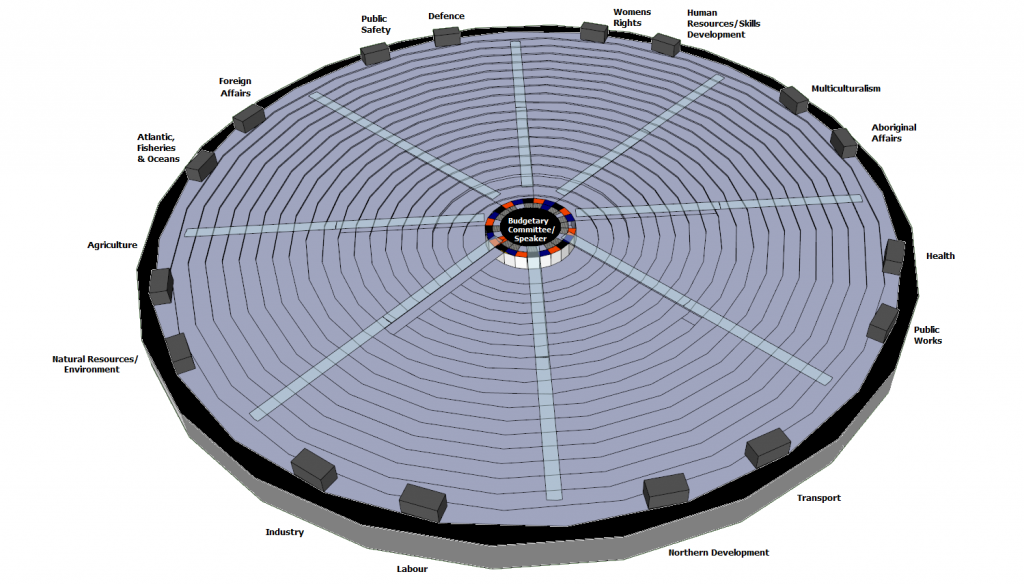
I believe that councils, where members of EACH political party WORK TOGETHER on crafting legislation with input from all parties, would work more smoothly than the current process, where one party drafts some proposals for law, and then it is debated ad nauseum in parliament until amendments are added and it is reintroduced weeks later for its second and third reading, etc.

This concept, of course, works best when each party has an appropriate number of seats in parliament, so for the purpose of this experiment, I presume that each party listed (except for the Green Party, which only recently gained its first elected member) has enough members to put one on every ministerial portfolio. In Canada's Parliament as it stands, there are 164 CPCs, 100 NDPs, and 35 LIBs - more than enough for each party to sit on all 16 listed ministries.

In my reworked model of parliament, the councils would all sit on the outside of the chamber, and when it is their turn to address parliament, they can do so either from their own seats, or from the central addressing platform, which is intended for all members of parliament to have equal opportunity to face them. Perhaps swivel chairs would be a good idea?

Instead of the hierarchical approach to seating that is present in most parliaments, I intend for my redesign to mimic the Round Table from the legends of King Arthur, as it implies equality between all members of parliament. You may notice that there seems to be no designated spot for the prime minister or leader of the opposition. If we still wish to have those positions, I believe that they can sit with the speaker of the house. Oh, and the Finance Ministry (with its three ministers from three different parties) is named the Budgetary Council in this diagram.

I also have a 3-D rendering of the new parliament chamber (click to zoom):

As you can see, the ministries all sit in a round, with the Budgetary Council and prime minister able to sit with the speaker in the centre, to direct the process. I believe that these changes to the way our government works would result in better governance for all Canadians.

So what do you think?

Wednesday, 17 April 2013

Thoughts for today

Taxes and Retirement Savings
I believe that all businesses (and all people receiving money from them) should be made to file their taxes electronically, with multiple backup systems available. (Including paper printouts when necessary). The employees should have access to these systems as well, to make filing taxes quick and easy (well, easier). I feel that if we filed taxes that way, tax dodgers would have nowhere to hide.

I also think that decentralization of assets away from major banks would be a good idea. The federal government should be able to keep a backup record of a person or company's financial records as a safeguard against data loss, but people should be able to keep their savings with them, in their own secure, biometric-activated "piggy bank" device. Even if the device were to be physically stolen, it would not be able to be used, because the device would be coded for its proper owner only.

Pension Plans
How are pension plans funded?
Taking a little bit out of your pay cheque every time to put it toward the future.
(Currently in Canada, I believe it is “5% of income between $3500 and $50,100”)

So what would I do if I had my own country to run?
I'd just say “do it yourself”, so that your retirement funds don't get loaded into a big pot that gets invested (and possibly lost on a bad investment). All investments carry risk, and as was seen with the housing crisis that launched the worldwide recession, that was one heck of a bad risk.
--
A careful budget would allow someone to set aside money for retirement on their own.
If you can make $16,000 per year (($400 X 40 weeks x $10 per hour) or (350x48x10)), and your costs of living are $400 per month for food, $500 per month for rent, and $80 per month for other things, then your total monthly expenditures on average will be $980 (yearly expenses: 11,760). $620 will be left over to be put toward retirement per month (Okay, the numbers are a little off – yearly savings of $4,240).
That's $4,240 per year. Over a period of 30 years, this simple frugality would give you $127,200.
If your monthly expenses remained at $980 after you retire, that amount of savings would keep you solvent for 130 months (10 years). So if you retired at 55, you would have enough savings to live until 65, just on your savings. Obviously, that's not enough, so let's extend the working period.
If you worked from age 25 until 65 (40 years under this model), your savings would end up being $169,600. That would be enough savings for 14 years (age 79, which is the average life expectancy for Canadian men).

Now, it is highly unlikely that people can be this frugal for 40 straight years, but even a 40-year savings of $100,000 from a theoretical maximum of $169,600 (spending of an extra $69,600 on trips or things over a time period of 40 years) would still give you enough savings for 8½ years of retirement (age 73). If you sell some of the items you accumulate over the years (even possibly your home, which you have been steadily paying off with rent over the last 40 years – I'll get to that in a minute), you could live comfortably for the rest of your days. And all this assumes that your salary does not increase at all over your entire working life, so the savings are likely to be higher.

*To put a point on selling your home: Let's say the assessed value of a 1000-square foot condo is $100,000 (not feasible in Sudbury, but I'm dreaming here, so leave it be). Under a payment plan of $$250 per month (let's say half the rent cost goes to this), the condo would be under your full ownership in 400 months (33 years, 4 months). So if you got your condo at age 25, you would fully own it by age 58. Not bad! That's a $100,000 asset that you can now sell at any time. Add that to the projected retirement savings of $100,000, and you now have 17 years of retirement savings, all without investing your money in any crazy schemes that would bankrupt the world.*


So why can't we do this now?
I've noticed that there's one thing that seems to cost a lot of money, but that most people seem to want/need in order to live independently in society. That thing is an automobile. Cars cost a lot of money, not just for the initial purchase or lease, but for upkeep, licensing, and worst of all, car insurance. I see ads on Spike TV for car insurance all the time, and I think to myself “That's nice and all, but I'd rather not have to own a car, and pay ZERO on my car insurance every month.” It would be one less expense to worry about for someone living on minimum wage.
So that's why I designed my compact cities. If you don't have to do a daily commute of half an hour in the car, it will save you a lot of money over your lifetime. And for those that still would have to commute to work (let's say lumberjacks, miners, etc.) because their workplace is in a remote location, their businesses should contribute funding to a train system that gets people to and from work reliably. If there's only one train on the track as opposed to hundreds of cars on a road, it's a lot less likely to have a collision. And what if the train system breaks down? Well, of course there should be a backup plan to get people to work. The backup system could be a road, I suppose, and people could ride electric vehicles to work if they needed to. My point is that this need not be an every day occurrence for 90+% of the population.

So what about all those people that would be put out of work in the auto industry if this were to happen?
I don't think those workers would necessarily have to lose their jobs at all - they would simply be changing industries. In switching to rail transport, a lot more manufacturers of rail-specific parts would be needed. I'm sure that with the proper training, auto assembly plant workers could make a smooth transition to manufacturing things such as motor scooters, emergency vehicles, and mass-transit systems. 

Friday, 12 April 2013

RBC - time to switch to a credit union?

I'm sure you all know what is going on with RBC.
Here's an interesting alternative:
http://www.wnyc.org/npr_articles/2013/apr/02/in-spain-a-mattress-that-lets-your-money-rest-easy/

The concept is pretty similar to my idea of having your own biometric activated, digital savings bank in your own home.

What do you all think about either of these ideas?

Tuesday, 2 April 2013

It's here!

I don't expect this initial campaign to be a success. In fact, the goal is very lofty, indeed. This campaign is about awareness. The Green Bay Packers are owned by 115,000 shareholders, not one of which receives a dividend. They do it because they want to see the team succeed.
My project has similar goals.

So here it is:
Making a movie | Indiegogo
Please join! It can only happen if we all work together!

Friday, 29 March 2013

So what would happen if...

Just a bit of open speculation today.
What would happen if we somehow managed to prevent inflation altogether, through a gradual phaseout of use of non-renewable resources, and a rethinking of how our economy is generated in the first place (i.e. zero interest loans - which I guess would be defined as grants).
Loans don't make a lot of sense to me. If you have X money available in the entire economy, how do you expect to get X+interest back unless you continually make more money and devalue your currency in the process? Zero-interest loans should exist and be used. This would help stabilize the world economy, by actually allowing people (and nations) to get a leg up instead of being buried under an ever-increasing mountain of debt. I realize that the credit card companies would go bankrupt by handing out zero-interest loans, but they seem to be one of the roots of the whole mess, to me. It's time for them to go.

(Tangent)
I myself have a credit card, and I hate it. I only use it when there is no other option of payment available. I would much prefer to use an instant money transfer service (debit) than a credit card, because I see where the money goes instantly, without having it sit on my mind for up to a month before paying it off. The illusion of having more money than you actually have is what drives people into the situations you see on shows like Til Debt Do Us Part. It's sad, really. We need to get rid of the opportunity for people to spend beyond their means. People will learn how to manage money wisely, and we will all be better off for it.

Friday, 22 March 2013

Trial separation?

It's clear that we in Canada are fractured as a nation - and not that I like to think about it, but I wonder if the often-mentioned balkanization of this country would become a reality in the not-distant future. The West resents the East because the West is under-represented in parliament. The East resents the West because they have dirty oil, etc. etc...perhaps a trial separation is in order.
I'd dissolve the federal government for about a year's time - effectively making us 13 jurisdictions under one common currency, like the EU. Then our provincial governments could set their own policies and run things as they see fit. If, after a year, the provinces are in better shape than they were under Confederation, we could hold a nation-wide referendum on how to move forward.


Thoughts?

Saturday, 9 March 2013

Asteroid mining?

Considering that my cities are designed to be enclosed loops, with little interaction with the natural world, they may necessarily need to reach out to other places beyond the Earth to find the resources required for continued existence. I am a big proponent of asteroid mining, as it would provide us with ample resources from throughout our Solar System. With the closed-loop design, the hope is that no contaminants would leak into the natural environment, but that we humans could still get what we needed for our society. The launch loop that I designed would be used to launch our miners into space. Once they have their cargo, in order to return to the surface, they could re-enter like the Shuttle does now, but I would prefer a controlled descent, in order to avoid a Russian meteor-type incident.

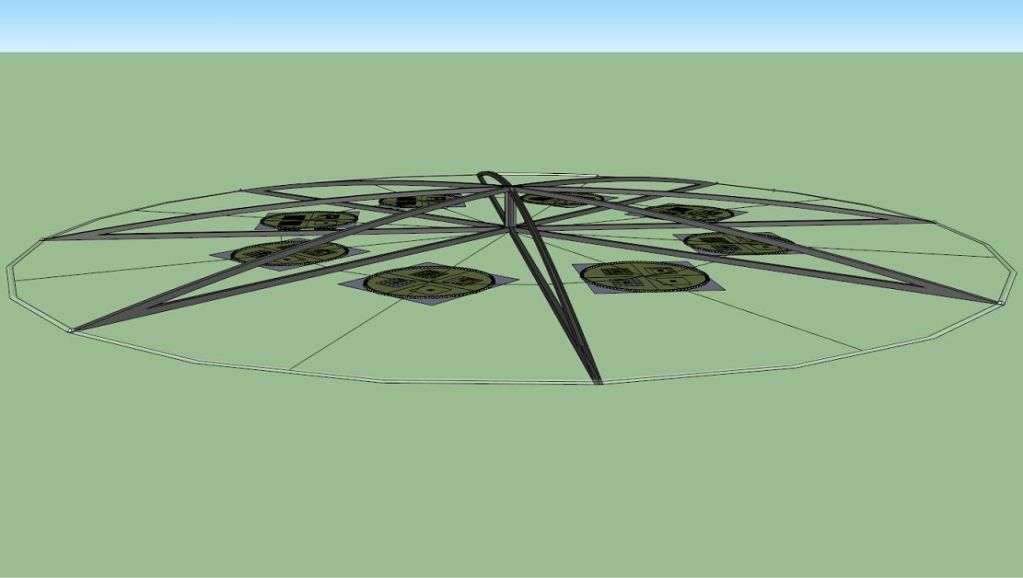
Here is the launch loop:

The concept shown needs a large flat area to be built (probably over the prairies). It is 200 km from one end to the other, and reaches a height of 10 km in the centre. It is a shallow-angled arc with an inital angle of less than 10 degrees. A vehicle needs to reach a speed of 11 kilometres per second in order to get into orbit. In this model the craft will be accelerated along the track at a rate of 4 G, (39.2 metres per second squared) or an increase in speed of 140 kph every second. Because this acceleration force can cause some people to black out, safety restraints will of course be used, as well as the option of putting passengers to sleep during launch. Acceleration time will be 5 minutes, covering a distance of 3300 km, most of which will be achieved after the vehicle exits the launcher. The advantage of the launch loop to traditional rockets is that once the vehicle exits this launcher, it will be clear of 99% of the atmosphere, which will drastically reduce the requirement for heat shielding on the craft, cutting down on energy requirements to get the craft moving. Also, while space-faring crafts may still use traditional rocket propulsion to complete acceleration, they need not be. Ion propulsion and other technologies can also be used
to complete acceleration to the speed needed to escape Earth's gravity.